Seven Lessons from the Day Job That Survive the Soundcheck

Photo by Photo by Iain on Unsplash on Unsplash
I have had a lot of day jobs. I have stacked shelves, answered phones, worked a kitchen pass, driven a van, and spent a memorable six months in a warehouse where the forklift had a name and a personality disorder. None of these jobs were about music. All of them taught me something about playing small rooms.
This is not a generic list about transferable skills. It is a specific list about the things that actually help when you are standing in a village hall with a borrowed amp and a setlist that is already out of date.
1. Read the room before you read the setlist
In retail, you learn to read a shop floor in about four seconds. Is it busy? Is it tense? Is there a queue? Is someone about to kick off because the card machine is down? You do not need a briefing. You need eyes.
Small rooms are the same. Before you plug in, look at the audience. Are they standing near the bar or near the stage? Are they talking? Are they sitting down? Are they waiting for permission to enjoy themselves? The setlist you wrote is a guess. The room is the information. Read it first.
2. Pace a shift, not a sprint
A kitchen shift taught me that you cannot sprint for eight hours. You have to find a rhythm. The same is true of a gig. If you come out of the blocks at full volume and full energy, you have nowhere to go. The audience gets tired. You get tired. The set becomes a flat line.
Pacing is not the same as holding back. It is about knowing where the peaks are and not spending them all in the first ten minutes. A good shift has a shape. So does a good set.
3. Complaints are information, not verdicts
I spent a year on a customer service line. It taught me that most complaints are not really complaints. They are people saying: I am frustrated and I need you to acknowledge it. You do not have to agree. You just have to listen.
A heckle is a complaint. A bad review is a complaint. A promoter telling you the set was too long is a complaint. None of them are verdicts on your worth as a human being. They are information about the room, the night, or the person. Take the information. Leave the verdict.
4. Keep your kit tidy
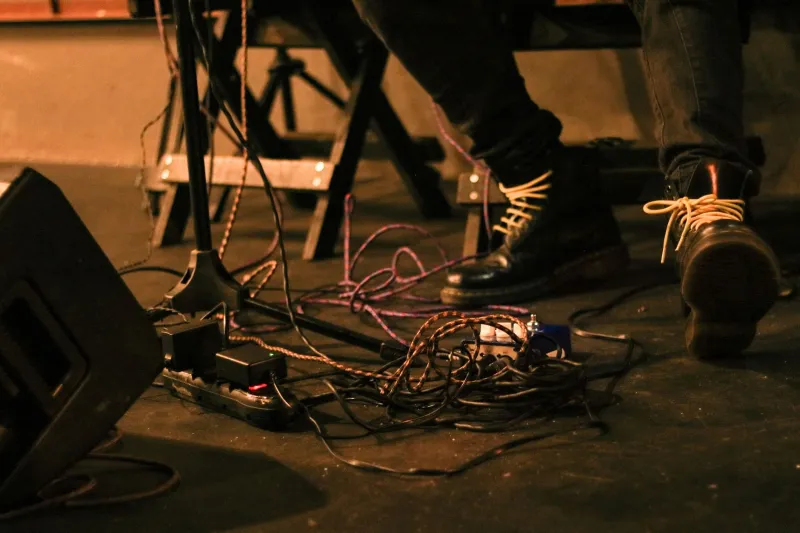
In a workshop, you learn that a tidy bench is not about aesthetics. It is about being able to find the thing you need in the dark. A messy bench slows you down. A messy kit does the same.
Small gigs are full of dark corners and short changeovers. If your cables are coiled properly and your pedals are in the right order and your spare strings are where you can find them, you will be faster and calmer. Tidiness is a form of respect for the next person, and for yourself.
5. Handover notes beat memory
Every shift job I have had involved some kind of handover. A note to the next person: the till is low, the oven is on, the delivery has not arrived, the key is under the mat. You do not rely on memory. You write it down.
A setlist is a handover note. So is a stage plot. So is a guest list. So is a text to the promoter saying you are running ten minutes late. The more you write down, the less you have to carry in your head. In a small venue, where everyone is doing three jobs, that matters.
6. Do not argue with the queue
In front-of-house work, you learn that the queue is not your enemy. It is a physical fact. You can manage it, but you cannot argue it away. The same goes for the audience at a small gig. They will arrive when they arrive. They will stand where they stand. They will talk during the quiet song.
You can try to fight it. You will lose. Better to work with it. Play to the people who are listening. Do not scold the ones who are not. The queue is not personal. Neither is a chatty back row.
7. Leave the place as you found it
This is the big one. In every job I have had, there is a version of this rule. Clean the pass. Stack the chairs. Take the rubbish out. Leave the van with the same amount of fuel you found it with.
Small venues run on this. You borrow a room, a PA, a DI box, a chair. You leave it as you found it, or better. You coil the cables. You take your pint glasses back. You thank the person who opened the door. It is not admin. It is the infrastructure of the scene.
The day job is not the opposite of the gig. It is the rehearsal for it. The skills are the same: attention, pacing, patience, tidiness, and the ability to read a room before you open your mouth.