Stapled, Not Scrolled: Why the Zine Table Still Matters
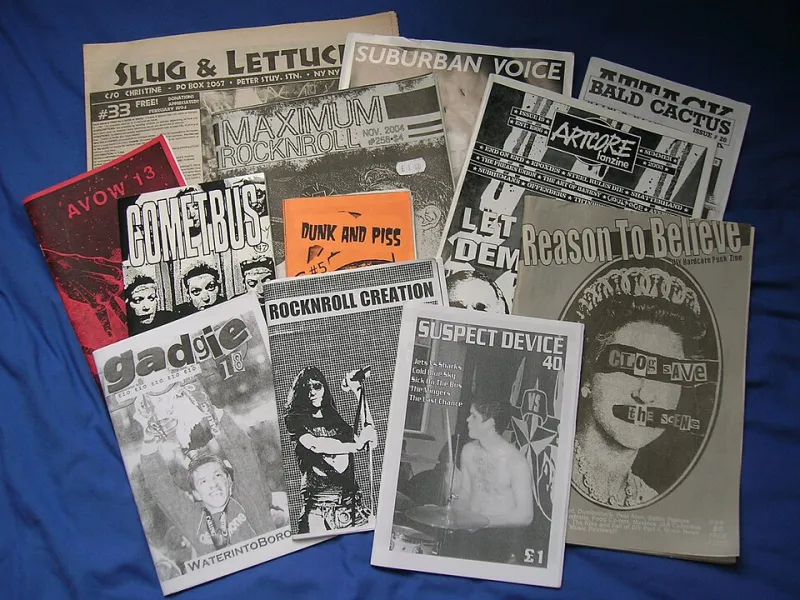
Photo: Burn_the_asylum (uploader, on 25 March 2005), CC BY-SA 3.0, via Wikimedia Commons
At a gig in Leeds last month I watched someone buy a seven-inch, a badge and a photocopied zine. The seven-inch was the reason they came. The badge was a souvenir. The zine was the thing they read on the bus home. That order of priorities has stayed with me.
The zine table is not a nostalgia project. It is a working part of a scene. It sits next to the merch because it belongs there: low cost, high personality, made by someone who was in the room. It is also a useful corrective to the way so much independent culture now gets flattened into a feed. A zine has edges. It has a cover, a staple, a person’s handwriting, a bad photocopy and a decision about what not to include. In 2026, that is not a small thing.
The economics of a photocopy
A zine is cheap enough to risk. That is its great advantage. You can make twenty copies of something for the price of a couple of pints, put them on a table with a handwritten sign and see what happens. You do not need a launch strategy. You need a photocopier, a stapler and an idea that is worth eight pages.
The low cost changes the relationship with the reader. A £2 zine is not a luxury product, and it is not a free content funnel. It is a small transaction with a person. Someone has made a thing, and someone else has decided to take it home. That is a different kind of attention from a scroll. It is slower, more deliberate and much easier to remember.
It also keeps the barrier low for the maker. A teenager with a printer and a point of view can be part of the conversation. A band can document a tour without waiting for a label. A scene can record its own arguments, gig lists, bad drawings and good recommendations without asking a platform for permission. The zine table is one of the few places left where the cost of publishing is low enough that the work can still be awkward, personal and unfinished.
Make it like a letter, not a campaign
The worst zines are the ones that feel like brand exercises. You can spot them: too much polish, a QR code on every page, a call to action where a story should be. The best ones feel like a letter from someone who could not help themselves. They have a voice. They have a bias. They have a favourite record and a reason.
So start small. Take one sheet of A4, fold it to A5, and give yourself eight pages. Write about something you actually saw. Review a gig in your own town. Interview the person who runs the record stall. Draw the venue. List the seven songs you played in the van. Keep it legible, but do not sand off the personality. A zine does not need to look professional. It needs to look like someone meant it.
A long-arm stapler is useful. So is a decent photocopier and a friend who can spot a typo. Do not spend weeks on a logo. Do not build a content calendar. Make one issue, print twenty, and take it to a gig. If it sells, make another. If it swaps, even better.
Swap, don’t gatekeep
The swap is the secret engine of zine culture. You make something, someone else makes something, and you trade. That is how a scene publishes itself without money changing hands in any meaningful way. It is also how you meet people who are doing the same odd thing as you, which is often the real point.
At record fairs and community events, a swap table can be more interesting than the paid table. Bring a few copies. Leave room for other people’s work. Put your name and contact on the back, but do not turn the whole thing into a mailing list. The pleasure is in the exchange, not the capture.
And if you are organising a gig or a fair, make space for it. A small table near the door costs almost nothing. It tells people that the event is not only a transaction. It says that the scene has a memory, a mouth and a photocopier.
Archive it before it disappears
Zines vanish. They get left on trains, stuck in folders, thrown out in house moves. If you make one, keep a copy for yourself. Write the date and the place on it. If you are given one, put it in a shoebox or a folder rather than a display case. The point is not to create a museum. The point is to keep the evidence.
A simple archive is enough: one box for gigs, one for record fairs, one for things people gave you. Label them if you are the labelling type. Do not laminate everything. Do not turn it into an institution. Just keep the paper safe enough that someone can find it in ten years and think, oh yes, that was the night.
The zine table earns its place because it is small, cheap and human. It does not need to scale. It does not need to become a brand. It needs a stapler, a stack of paper and someone willing to put their name on a thing and leave it by the door. That is still a good way to publish. It is still a good way to be part of a scene.