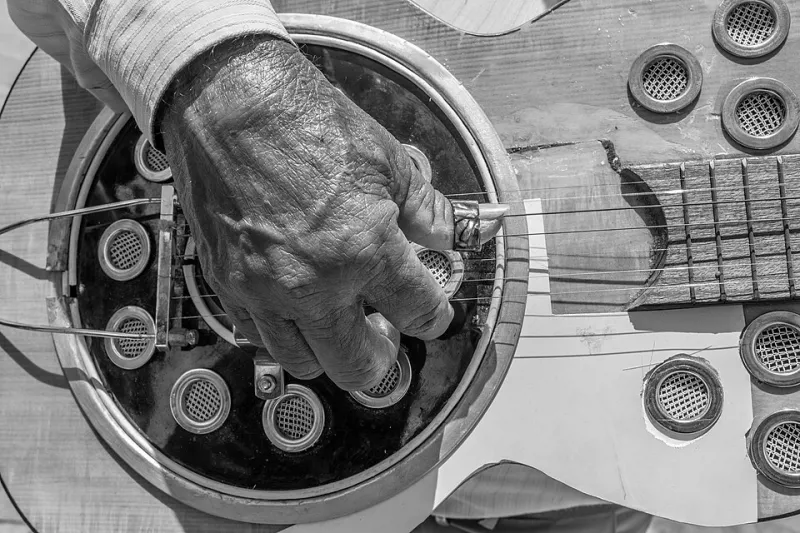
Return It With Fresh Strings: The Quiet Etiquette of a Borrowed Rig
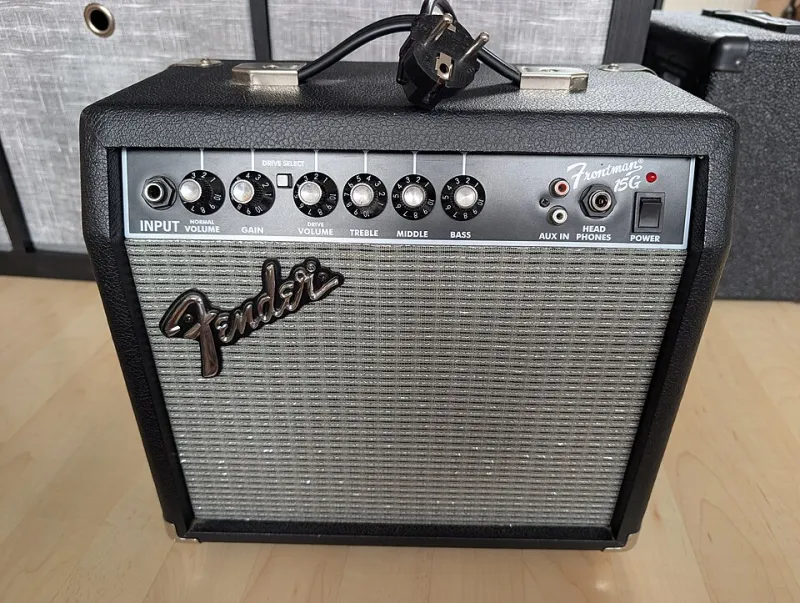
Photo: Elmschrat, CC BY-SA 4.0, via Wikimedia Commons
The first amp I borrowed arrived with a Post-it note stuck to its top panel. Three instructions, in biro: don't put it on the floor, don't lend it on, and have it back before Thursday. The amp was a scuffed 1x12 combo that had already survived two decades of pub gigs. That note was the entire contract. I was nineteen, I had a gig on the Friday, and I had no amp of my own.
The Kit That Travels Sideways
Every small scene I've been part of runs on a shadow inventory. Not the gear in the publicity photos — the other gear. The second amp that lives in someone's hallway. The drum kit in a case with a missing wheel that three bands quietly regard as theirs. The pedalboard that's been rewired by six different people and now contains at least one pedal nobody can identify with any certainty.
None of this appears on a balance sheet. It doesn't need to. It moves sideways, between people who've played the same function room above a pub in Levenshulme, the same village hall in Fife, the same shared lock-up in Bristol with the door that needs lifting before it'll close. A bassist's spare head goes out on Saturday and comes back on Tuesday. A keyboard stand has a summer that reads like a touring schedule.
The economics are obvious enough. A young band can't buy a decent valve amp and a drum kit and a PA in the same month, and probably shouldn't. Borrowing keeps four or five working rigs in circulation rather than asking every new band to start from zero. It also means a gig can happen when someone's amp dies at soundcheck and the nearest replacement is a phone call, not a trip to Cash Converters.
Gaffer Tape and Initials
Borrowed gear gets marked. Not always neatly. You'll see initials in marker on the back of a cabinet, a strip of gaffer tape on a pedal with a name and a mobile number that's two digits out of date, a PAT test sticker from 2019 that nobody has the heart to peel off. The markings are a kind of passport. They say this thing has an owner, and the owner has a history of letting people use it.
The handover is a small ritual of its own. You get the amp, and you get the story of the amp — the input that crackles if you push it, the reverb that only works if you switch it on and off twice, the valve that was replaced in a hurry before a wedding gig in Salford. You nod. You remember about half of it. Then you load it into a car and hope the other half doesn't matter.
Maintenance as Good Manners
The etiquette isn't written down, but it's fairly consistent. You return things clean. You return them with fresh strings if they're stringed instruments, or at least with a pack of strings in the case. You don't return a pedal with a battery in it that's nearly dead, because the next person will spend twenty minutes assuming the pedal itself has failed. If you own a soldering iron, you become, whether you like it or not, part of the scene's repair infrastructure.
Some of this is practical. A scratchy volume pot on a shared amp is everyone's problem. But some of it is social. Looking after a borrowed thing is how you signal that you'd like to keep being lent things. The people who are careless with gear tend to find that gear becomes harder to come by.
I've known scenes where a borrowed amp came back with a note listing what had been fixed — a jack tightened, a valve swapped, a fuse replaced. That note is worth more than an apology for a broken one.
The Careful Scene
The awkward part is that care can tip into caution. Once a scene gets a bit more professional — real fee splits, a couple of people with public liability insurance, a promoter who asks for backline details in advance — the lending can tighten. Gear becomes an asset. People start saying 'it's on the rider' instead of 'I'll bring a spare'. Nobody's being difficult; they've got a van to insure and an amp that cost more than their first car.
There's a real gain in that. Proper PAT testing, decent cases, gear that doesn't buzz — all good. The loss is more subtle. When lending gets rarer, the informal network that used to carry a new band through its first year gets thinner. A young player ends up buying a cheap amp that sounds worse than the borrowed one they can no longer get, or not playing at all. The scene becomes better equipped and slightly less porous.
I don't think the answer is to romanticise the scruffy version. A borrowed amp that's never been tested isn't a charming tradition; it's a fire risk with a speaker cone. The trick, maybe, is to keep the generosity while tidying up the admin. A shared spreadsheet of who has what. A PAT test day in a village hall with a tea urn and a queue. Lending, but with a diary.
What Borrowing Actually Teaches
There's a musical education in all this that doesn't get much airtime. When you play through someone else's amp for six months, you learn what tone actually is — you find out how much of your sound lives in your hands and how much lives in a particular set of valves. You learn to turn up and make do. You learn that the difference between a good gig and a bad one is rarely the gear, though gear can absolutely ruin an evening if it fails at the wrong moment.
And you learn the shape of your scene. Not from a directory, but from who answers a message at 4pm on a Friday. The amp with the Post-it note taught me more about how music works locally than most advice I was given at the time. Not because it was a good amp — it wasn't, especially — but because it existed, it was offered, and it came back.
There's no catalogue for any of this. There's just the note on the top panel, and whether you bring it back with fresh strings.