Drafts in the Dark: Reading a Setlist for the Songs It Left Out
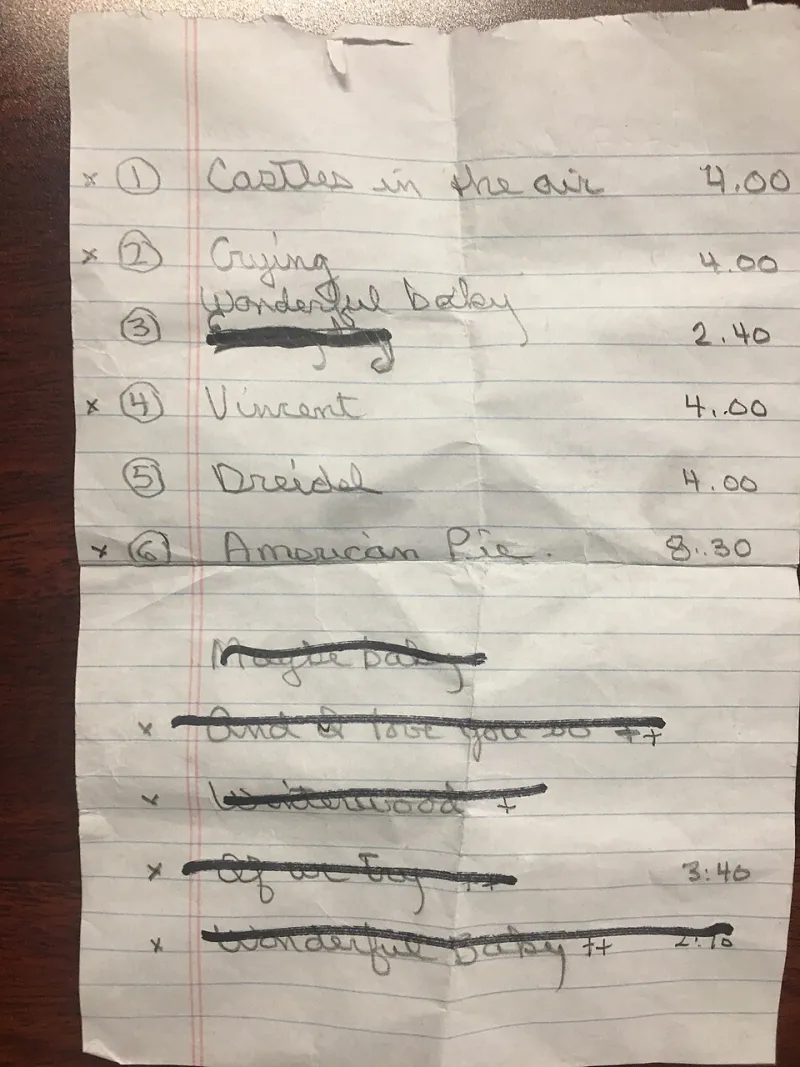
Photo: JeremyWestby, CC BY-SA 4.0, via Wikimedia Commons
I have a drawer full of setlists. Some are mine. Some were picked up off the floor of village halls, arts centres, and the kind of back rooms where the radiator clanks through the quiet bits. None of them are clean. That is the point. A clean setlist is a fiction. A working setlist is a document of doubt.
The setlist as a hypothesis
A setlist is written before the gig, which means it is written by a person who has not yet met the room. It is a hypothesis about what might work. Then the room arrives, and the hypothesis is tested, and the setlist is revised in the dark with a biro that never quite works at the angle required. You can see the revisions. An arrow from song four to song seven. A song crossed out entirely. A question mark next to a ballad. The word MAYBE in capitals, underlined twice.
In small rooms, this is not unprofessional. It is the job. The setlist is a live document because the audience is a live audience. You read them. You adjust. You drop the new one because it is not landing, or you keep it because someone in the front row is nodding in a way that suggests they need it. The setlist is where that negotiation becomes visible.
What a crossing-out actually says
A crossing-out is not a rejection of the song. It is a rejection of the song in that room, on that night, at that point in the set. That is a subtle but important distinction. I have crossed out songs I love because they were too slow for a Friday night, or too fast for a room that had just sat through a poetry reading. I have crossed out songs because my voice was tired, or because the capo was in the wrong place, or because I caught sight of the clock and realised I had fifteen minutes, not twenty.
The setlist records those decisions without explaining them. That is why it is such a good document. It is a paper trail of instinct. You can look at a setlist from a gig in 2026 and remember exactly why you dropped the third song, even if the reason was as trivial as a broken string or a heckle from the back.
Reorderings and the shape of a room
The reorderings are the most interesting part. A setlist that has been reordered tells you that the original plan was wrong. Maybe the room was livelier than expected, so the quiet song got moved later. Maybe the room was quieter than expected, so the loud song got moved earlier. Maybe the gig was running late, so the whole thing got compressed.
In a small venue, the shape of the room is not fixed. A village hall with the chairs out is a different room from the same hall with the chairs stacked. A back room with a low ceiling is a different room from a back room with a high one. The setlist has to respond to that. A good setlist is not a sequence of songs. It is a sequence of rooms, imagined in advance and then corrected in real time.
The songs that never get played
Then there are the songs that stay on the setlist but never get played. They sit there, crossed out or bracketed, and they become a kind of ghost repertoire. You carry them from gig to gig. You keep thinking you will bring them back. You never do. They are the road not taken, written in biro.
I have a setlist from a gig in autumn 2026 with a song at the bottom that has been crossed out and re-written and crossed out again. I know exactly why. It is a song that needs a certain kind of attention, and the room that night was not giving it. So it stayed in the drawer, and the setlist kept its record of that decision.
Why the paper matters
You could keep a setlist on a phone. People do. But a phone does not show the crossings-out in the same way. A phone does not crease. A phone does not get beer on it. A phone does not get folded into a back pocket and forgotten. The paper setlist is a physical record of a physical night. It is the paper trail of a gig, and it is worth keeping.
So I keep them. Not because they are precious, but because they are honest. They show the working. They show the doubt. They show the songs that got left out, which are often the songs that tell you most about what the room needed.